
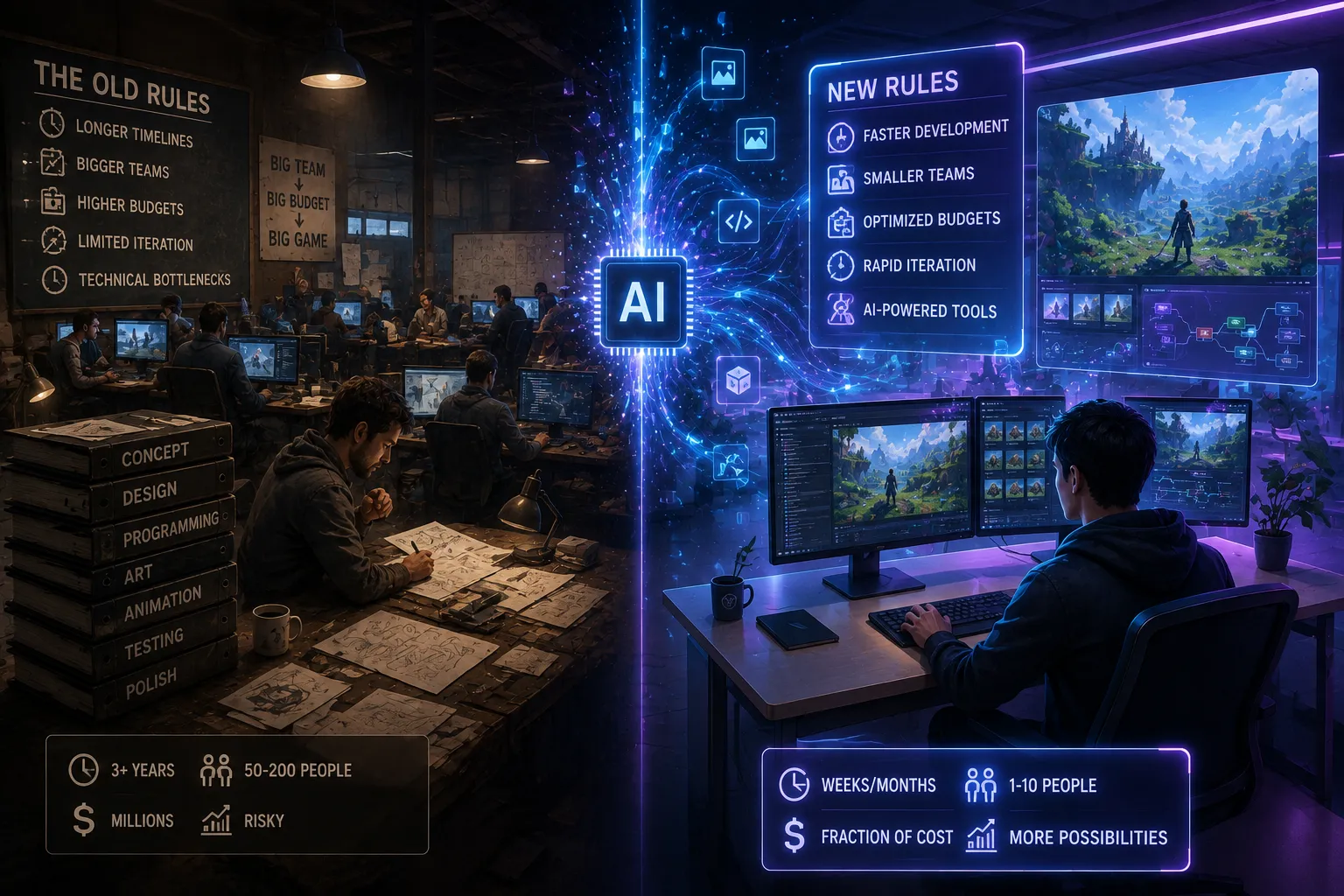
Every industry eventually hits a point where the old rules stop applying, not because they were wrong, but because the conditions that made them necessary no longer exist. Game production is at that point now. The rules that shaped decades of development, longer timelines mean better games, bigger teams mean bigger scope, more budget means more polish, are all loosening at once, and AI is the reason why.
The Rules That Used to Govern Everything
For most of gaming history, production followed a fairly predictable logic. Ambitious games needed large teams. Large teams needed significant funding. Significant funding meant longer development cycles to justify the investment. Every part of that chain reinforced the others, which meant the games that reached players were shaped as much by budget and headcount as by the strength of the underlying idea.
This wasn’t a flaw exactly, it was just how production had to work when every system, every mechanic, every line of polish required dedicated technical labor to build. The rules made sense given the constraints. The problem is that the constraints themselves are changing.
How AI Is Rewriting Each Rule
Timelines No Longer Scale the Same Way With Ambition
Traditionally, a more ambitious game simply took longer to build, since every additional system meant additional technical implementation time. AI tools compress that relationship significantly. A team can now pursue more ambitious scope without the corresponding jump in production time that used to make ambition and speed mutually exclusive.
Team Size Stops Being the Primary Constraint on Scope
Scope used to scale directly with headcount, more people meant more features, more content, more polish. AI-assisted development weakens that connection. A smaller team can now execute on a larger scope than their headcount would traditionally allow, since much of the technical labor that used to require additional hires can now be handled through faster, AI-supported implementation.
Budget Stops Being the Clearest Predictor of Quality
Production value has long correlated closely with how much money a project had behind it. That correlation is weakening as AI tools narrow the gap between what a well-funded team can produce and what a smaller, leaner team can achieve. Quality increasingly depends on design judgment and iteration discipline rather than sheer financial resources.
What This Actually Looks Like on the Ground
Games With Real Scope Coming From Small, Lean Teams
Minecraft HD reflects where this shift is already showing up, a game with genuine depth and polish built without the large-scale production pipeline that projects at this level traditionally required. It’s a preview of what smaller teams are increasingly capable of producing.
Faster Movement From Concept to Playable Version
Prototyping used to be treated as a distinct early phase, separate from full production and heavily gated by technical setup time. Now, prototyping and iteration blend together far more fluidly, since testing a rough version of an idea no longer requires the same upfront technical investment it once did.
More Creators Entering Production Roles Directly
People using an AI game maker today increasingly include creators who would never have had a realistic path into production under the old rules, people without formal technical training who nonetheless understand what makes a game genuinely fun. Their entry into production isn’t a lowering of standards, it’s an expansion of who gets to try.
What Hasn’t Changed, Even as the Rules Do
Good Production Still Requires Discipline
Faster tools don’t remove the need for disciplined scoping, honest prioritization, and a clear sense of what a project actually needs versus what would just be nice to have. If anything, the temptation to overbuild becomes more dangerous when technical barriers are lower, since there’s less friction naturally limiting scope creep.
Playtesting Remains as Critical as Ever
No amount of production speed replaces the value of watching real players interact with a game and adjusting based on what actually happens. Faster iteration should mean more testing, not less, since there’s more room to act on feedback before decisions get locked in.
Creative Vision Still Comes From People, Not Tools
AI can execute described mechanics quickly, but it doesn’t decide what a game should feel like, what its identity is, or why a particular decision serves the overall experience. Those calls remain entirely human, regardless of how much technical friction gets removed from the process around them.
Why These Changes Are Likely to Stick
Rule changes driven by genuine technical shifts tend to be durable rather than temporary. The relationship between team size, budget, and production scope isn’t loosening because of a passing trend, it’s loosening because a real structural constraint, the technical labor required to build a game, has been meaningfully reduced. That kind of change doesn’t tend to reverse itself once the tools enabling it keep improving rather than stagnating.
This also means the studios and teams that adapt fastest to the new rules are likely to hold a lasting advantage over those still operating under the old assumptions about what team size and budget require.
Final Thoughts
AI is changing the rules of game production not by making bad ideas good, but by removing the constraints that used to force good ideas into smaller shapes than they deserved. Timelines, team size, and budget still matter, but they no longer dictate outcomes the way they once did. What’s left standing as the real differentiator is exactly what it should have always been, the strength of the idea and the discipline of the people building it.
