
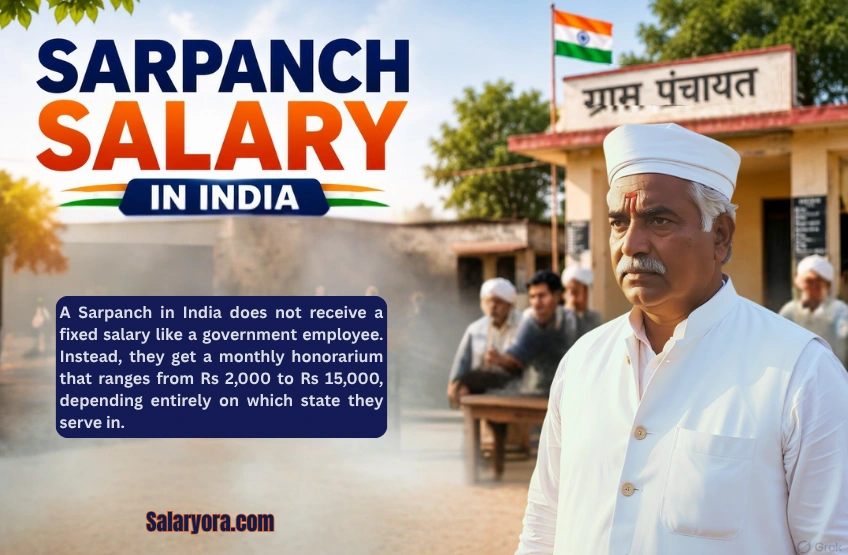
A Sarpanch in India does not receive a fixed salary like a government employee. Instead, they get a monthly honorarium that ranges from Rs 2,000 to Rs 15,000, depending entirely on which state they serve in.
Read on for a complete state-wise picture of Village Sarpanch Salary in 2026, including allowances, Upa Sarpanch salary, and the latest hikes across Gujarat, Punjab, Haryana, Bihar, Odisha, Telangana, Maharashtra, and Madhya Pradesh. The Village Sarpanch Salary structure differs significantly from state to state, so the numbers below matter more than any single national average.
Last Updated: July 17, 2026
Disclaimer: The salary and honorarium figures presented in this article are based on official state government notifications, verified media reports from credible news organisations, and publicly available Panchayati Raj department circulars. Estimated ranges are clearly marked. Since honorarium rates can be revised by state governments at any time, readers are advised to verify the latest figures directly from their respective state’s Panchayati Raj and Rural Development Department website before making any decisions.
Quick Stats: Sarpanch Salary In India At a Glance (2026)
| Parameter | Details |
|---|---|
| Minimum Monthly Honorarium | Rs 2,000 to Rs 6,000 (varies by state) |
| Maximum Monthly Honorarium | Rs 15,000 (select states/large GPs) |
| National Average Range | Rs 3,000 to Rs 10,000 per month |
| Annual Income (Estimated) | Rs 36,000 to Rs 1,80,000 |
| Equivalent LPA (Low End) | Approx. 0.36 LPA |
| Equivalent LPA (High End) | Approx. 1.80 LPA |
| Pay Type | Honorarium (Not a Salary) |
| Employment Type | Elected Representative (Not a Govt Employee) |
| Term Duration | 5 Years |
| Paid By | State Government and/or Gram Panchayat Fund |
Important Note: The amount a Sarpanch receives is called an “Honorarium,” not a salary. A Sarpanch is an elected representative, not a government employee, and therefore does not receive DA, HRA, NPS, or gratuity like regular government servants.
What Is a Sarpanch? Role and Responsibilities
Before we dive into the Sarpanch Ki Salary numbers, it helps to understand who a Sarpanch is and what they actually do.
A Sarpanch is the elected head of a Gram Panchayat, the smallest unit of local self-governance in rural India. This position was formally established under the 73rd Constitutional Amendment of 1992, which gave constitutional recognition to Panchayati Raj Institutions (PRIs) across the country.
The Sarpanch serves as the bridge between the village community and the district administration. Their key duties include:
- Conducting Gram Sabha meetings and chairing Gram Panchayat sessions
- Overseeing implementation of central and state rural development schemes (MGNREGA, PMAY-G, Jal Jeevan Mission, Swachh Bharat, etc.)
- Managing the village budget and development funds
- Approving local infrastructure works like roads, drains, handpumps, and school buildings
- Resolving disputes at the village level
- Maintaining official village records and facilitating coordination with block-level officers
Given this wide range of responsibilities, the Village Sarpanch Salary or honorarium is widely considered insufficient, and many state governments are now revising their rates upward.
Why Is Sarpanch Salary Called an Honorarium?
This is a question many people ask when they first look up Sarpanch Salary Per Month.
Unlike a government employee, a Sarpanch is a publicly elected representative. They do not clear any competitive exam, sit in a pay matrix, or draw a structured government salary. Instead, state governments fix a monthly honorarium under their respective Panchayati Raj Act. This amount is symbolic in many states and is meant to partially cover out-of-pocket expenses, not replace full-time employment income.
In practice, many Sarpanches hold separate occupations such as farming, trade, or teaching, and serve their village role alongside their regular work.
Sarpanch Salary In India: State-Wise Monthly Honorarium Table (2026)
The Gram Panchayat Sarpanch Salary varies significantly from one state to another. Here is a verified, state-wise table based on the most recent government notifications and announcements:
| State | Monthly Honorarium (Rs) | Annual Income (Rs) | Approx. LPA | Recent Update |
|---|---|---|---|---|
| Rajasthan | Rs 6,072 | Rs 72,864 | 0.73 LPA | 10% hike from April 2025 |
| Haryana | Rs 5,000 | Rs 60,000 | 0.60 LPA | Increased from Rs 3,000 (2023) |
| Bihar | Rs 5,000 | Rs 60,000 | 0.60 LPA | 100% hike from April 2024 |
| Odisha | Rs 10,000 | Rs 1,20,000 | 1.20 LPA | Significant hike, March 2024 |
| Telangana | Rs 8,000 to Rs 10,000 | Rs 96,000 to Rs 1,20,000 | 0.96 to 1.20 LPA | Includes development fund |
| Maharashtra | Rs 6,000 to Rs 10,000 | Rs 72,000 to Rs 1,20,000 | 0.72 to 1.20 LPA | Doubled via cabinet decision, Sept 2024 |
| Gujarat | Rs 3,000 to Rs 5,000 | Rs 36,000 to Rs 60,000 | 0.36 to 0.60 LPA | Per 2019 GD, population-based |
| Punjab | Rs 10,000 (from Aug 15, 2026) | Rs 1,20,000 | 1.20 LPA | Five-fold hike from Rs 2,000 announced June 2026 |
| Madhya Pradesh | Rs 3,000 to Rs 4,000 | Rs 36,000 to Rs 48,000 | 0.36 to 0.48 LPA | Based on 2023 announcements |
| Andhra Pradesh (AP) | Rs 3,000 to Rs 6,000 | Rs 36,000 to Rs 72,000 | 0.36 to 0.72 LPA | State Panchayati Raj norms |
| Uttar Pradesh | Rs 3,500 to Rs 5,000 | Rs 42,000 to Rs 60,000 | 0.42 to 0.60 LPA | Meeting allowance extra |
| Goa | Rs 8,000 | Rs 96,000 | 0.96 LPA | Rs 2,000 hike approved July 2024 cabinet |
| Kerala | Rs 7,000 to Rs 10,000 | Rs 84,000 to Rs 1,20,000 | 0.84 to 1.20 LPA | As per 2016 GO |
Data Source: State government notifications, Panchayati Raj department circulars, and verified media reports. Figures reflect the latest available data as of July 2026. Always cross-check with your respective state’s Panchayati Raj department for the most current notifications.
Sarpanch Salary In Gujarat: Detailed Breakdown
Sarpanch Salary In Gujarat is determined by a population-based slab system established under a Government Decision (GD) issued in 2019. Here is how it works:
| Village Population Category | Monthly Honorarium (Sarpanch) | Monthly Honorarium (Upa Sarpanch) |
|---|---|---|
| Below 2,000 population | Rs 3,000 | Rs 1,000 |
| 2,001 to 8,000 population | Rs 4,000 | Rs 1,500 |
| Above 8,001 population | Rs 5,000 | Rs 2,000 |
Funding Pattern: 75% of the honorarium comes from the state government, while the remaining 25% is sourced from the Gram Panchayat’s own fund. The Sarpanch Salary Gujarat therefore depends partly on whether the village panchayat has its own revenue-generating resources.
Key Context for Gujarat: As of June 2025, there is no officially announced revision in Gujarat’s Sarpanch honorarium structure beyond the 2019 slab-based system. The Gujarat Panchayat Parishad had previously proposed a Rs 5,000 flat monthly payment for all Sarpanches, acknowledging the out-of-pocket expenses many Sarpanches bear.
Sarpanch Salary In Punjab: Major 2026 Hike
Punjab has had a long and difficult history with Sarpanch pay. Sarpanches in Punjab were getting only Rs 1,200 per month under earlier regimes, and many went without payment for years, leading to court battles in the Punjab and Haryana High Court.
In April 2024, Chief Minister Bhagwant Mann raised the monthly honorarium from Rs 1,200 to Rs 2,000. Then, in a landmark announcement on June 24, 2026, at a Sarpanch Milni in Bathinda, CM Bhagwant Mann announced a further five-fold increase, raising the honorarium from Rs 2,000 to Rs 10,000 per month, effective August 15, 2026. This applies to all Sarpanches across Punjab’s 13,238 Gram Panchayats.
| Designation | Old Honorarium | New Honorarium (Aug 15, 2026) |
|---|---|---|
| Sarpanch | Rs 2,000 | Rs 10,000 per month |
| Panch | No official honorarium | Not announced (as of July 2026) |
Punjab’s Rs 10,000 monthly honorarium makes it one of the highest-paying states in India for Sarpanch Ki Salary and is being described as one of the largest single hikes to Sarpanch Salary In India in recent history.
Sarpanch Salary In Haryana: Hike and Current Status
Sarpanch Salary In Haryana has seen a notable revision. On July 11, 2023, the Haryana government issued a notification increasing the honorarium of Sarpanches from Rs 3,000 to Rs 5,000 per month, effective from April 1, 2023. This was in response to long-standing demands from Sarpanch bodies across the state.
| Designation | Previous Honorarium | Current Honorarium (2026) |
|---|---|---|
| Sarpanch | Rs 3,000 per month | Rs 5,000 per month |
| Panch (Ward Member) | Rs 1,000 per month | Rs 1,600 per month |
The Haryana government is also considering a proposal to provide health insurance coverage to Sarpanches and their families as part of a broader benefits package.
Sarpanch Salary In Bihar: 100% Hike in 2024
Bihar made a significant policy change in January 2024, when the state cabinet approved a 100% doubling of the monthly honorarium for Panchayati Raj representatives, effective April 1, 2024.
| Designation | Old Honorarium | New Honorarium (2024 Onwards) |
|---|---|---|
| Sarpanch / Mukhiya | Rs 2,500 | Rs 5,000 per month |
| Up-Sarpanch / Up-Mukhiya | Rs 1,250 | Rs 2,500 per month |
| Ward Member | Rs 500 | Rs 800 per month |
Payments are made directly to the bank accounts of the elected representatives. The Bihar government also introduced a Rs 5 lakh insurance cover for families in the unfortunate event of a Panchayat representative’s death while in office.
Sarpanch Salary In Odisha: Major Revision in 2024
Odisha carried out one of the most significant revisions to Sarpanch pay in recent years. Effective March 12, 2024, the Odisha state government substantially raised the monthly remuneration for Panchayati Raj officials.
| Designation | Old Monthly Remuneration | New Monthly Remuneration (2024) |
|---|---|---|
| Sarpanch | Rs 2,350 | Rs 10,000 |
| Naib Sarpanch (Upa Sarpanch) | Rs 490 | Rs 4,000 |
| Ward Member | Per-meeting basis only | Rs 480 per meeting day |
| Zilla Parishad President | Rs 9,380 | Rs 30,000 |
The Odisha revision was a landmark move and is being closely watched by other states as a benchmark for fair PRI compensation. The Sarpanch salary in Odisha has now moved meaningfully higher, making it one of the better-paying states for gram panchayat leadership roles.
Sarpanch Salary In Maharashtra: Doubled Slabs from 2024
Sarpanch Salary In Maharashtra follows a population-based slab system. In September 2024, the Maharashtra state cabinet approved a decision to double the honorarium for all Sarpanches and Upa Sarpanches ahead of the state assembly elections. The revised slabs, effective from late 2024, are:
| Population of GP | Old Monthly Honorarium (Sarpanch) | New Monthly Honorarium (Sarpanch) | New Monthly Honorarium (Upa Sarpanch) |
|---|---|---|---|
| Below 2,000 | Rs 3,000 | Rs 6,000 | Rs 2,000 |
| 2,001 to 8,000 | Rs 4,000 | Rs 8,000 | Rs 3,000 |
| Above 8,001 | Rs 5,000 | Rs 10,000 | (To be confirmed per GP) |
The state government funds 75% of the honorarium, while the remaining 25% comes from the Gram Panchayat’s own fund. The Gram Panchayat Sarpanch Salary in Maharashtra now ranges from Rs 6,000 to Rs 10,000 depending on village population, making it a significantly improved package compared to previous years.
Sarpanch Salary In Telangana and Andhra Pradesh (AP)
Telangana: Sarpanch Salary In Telangana is among the relatively better-paying states for village-level leaders. Monthly honorarium in Telangana ranges from Rs 8,000 to Rs 10,000. In addition, Sarpanches in Telangana are supported by a separate development fund, which gives them access to resources for village-level project implementation. Telangana panchayats are also considered technologically advanced, with digital payment infrastructure for many governance activities.
Andhra Pradesh (AP): Sarpanch Salary In AP varies under the state’s Panchayati Raj framework. The monthly honorarium ranges from Rs 3,000 to Rs 6,000 depending on the type and size of the Gram Panchayat. AP also provides meeting allowances for Gram Sabha sessions attended by the Sarpanch.
Sarpanch Salary In Madhya Pradesh (MP)
Sarpanch Salary In MP, based on the latest available notifications from 2023, places monthly honorarium in the Rs 3,000 to Rs 4,000 range. The figures have not seen a significant official revision as of mid-2026. MP also allows Sarpanches to undertake village development works up to a higher value threshold without mandatory e-tendering, giving them greater operational authority.
Upa Sarpanch Salary In India: State-Wise
The Upa Sarpanch (also called Up-Sarpanch, Deputy Sarpanch, or Naib Sarpanch) is the second-in-command of the Gram Panchayat. Upa Sarpanch Salary is generally 40% to 50% of what the Sarpanch receives.
| State | Upa Sarpanch Monthly Honorarium |
|---|---|
| Odisha | Rs 4,000 |
| Bihar | Rs 2,500 |
| Gujarat (Large GP) | Rs 2,000 |
| Maharashtra (Large GP) | Rs 2,000 |
| Haryana | Rs 1,600 (Panch level) |
| Rajasthan | Approx. Rs 2,000 to Rs 3,000 |
| Telangana | Approx. Rs 3,000 to Rs 4,000 |
| Punjab | Not officially fixed (2025) |
Sarpanch Salary Per Month vs Annual: LPA Conversion
Since most salary discussions in India now happen in LPA (Lakhs Per Annum), here is a quick conversion reference for Village Sarpanch Salary:
| Monthly Honorarium | Annual Total | LPA Equivalent |
|---|---|---|
| Rs 2,000 | Rs 24,000 | 0.24 LPA |
| Rs 3,000 | Rs 36,000 | 0.36 LPA |
| Rs 4,000 | Rs 48,000 | 0.48 LPA |
| Rs 5,000 | Rs 60,000 | 0.60 LPA |
| Rs 6,072 | Rs 72,864 | 0.73 LPA |
| Rs 8,000 | Rs 96,000 | 0.96 LPA |
| Rs 10,000 | Rs 1,20,000 | 1.20 LPA |
| Rs 15,000 | Rs 1,80,000 | 1.80 LPA |
| Rs 20,000 (Goa) | Rs 2,40,000 | 2.40 LPA |
Note: These figures represent honorarium income only. Most Sarpanches have other sources of income outside their elected role.
Additional Benefits and Allowances for Sarpanches
Beyond the basic monthly honorarium, a Sarpanch typically receives certain additional benefits depending on the state:
Travel Allowance (TA): Reimbursement or a fixed amount for travel to official meetings, block offices, or district headquarters.
Meeting Allowance: Extra payment for attending Gram Sabha sessions, block-level committee meetings, or special government review meetings.
Communication Allowance: Some states provide a mobile or internet allowance to cover the communication costs of running the panchayat.
Insurance Cover: States like Bihar have introduced life insurance of Rs 5 lakh for Panchayat representatives. Odisha provides Rs 2 lakh family compensation in the event of death on duty.
Training and Capacity Building: State governments and central agencies often offer free leadership and digital literacy training to elected Sarpanches, which helps them implement schemes more effectively.
Recognition and Awards: High-performing Sarpanches who deliver strong results under schemes like Swachh Bharat Mission, Jal Jeevan Mission, and PM Awas Yojana are eligible for state and national awards.
Sarpanch Salary Trend: How It Has Changed Over the Years
| State | Old Honorarium | New Honorarium | Year of Revision |
|---|---|---|---|
| Punjab | Rs 2,000 | Rs 10,000 | August 2026 (announced June 2026) |
| Maharashtra | Rs 3,000 to Rs 5,000 | Rs 6,000 to Rs 10,000 | September 2024 cabinet decision |
| Rajasthan | Rs 4,800 | Rs 6,072 | April 2025 |
| Haryana | Rs 3,000 | Rs 5,000 | April 2023 |
| Bihar | Rs 2,500 | Rs 5,000 | April 2024 |
| Odisha | Rs 2,350 | Rs 10,000 | March 2024 |
| Punjab (Prior) | Rs 1,200 | Rs 2,000 | April 2024 |
The overall trend across states is positive. Most state governments are acknowledging that the old honorarium rates were insufficient and are gradually increasing them. Odisha and Bihar stand out as states that have made bold revisions in 2024.
Real Income Beyond the Honorarium: What Sarpanches Actually Earn
A common and valid question among readers is: why do people spend lakhs to win a Sarpanch election if the monthly pay is so low?
The answer lies in the distinction between the official honorarium and the broader economic and social power that comes with the position.
Development Fund Control: A Sarpanch oversees significant village development budgets from MGNREGA, PMGY, state schemes, and Finance Commission grants. The annual development budget managed by a Gram Panchayat can range from Rs 10 lakh to several crores, depending on state and village category.
Village Common Land Leases: In some panchayats, revenue generated from leasing village common lands (shamlat land) is shared or managed by the Gram Panchayat. This can supplement overall panchayat income and indirectly support the Sarpanch’s ability to discharge duties.
Contractor and Vendor Network: While regulations exist to prevent corruption, in practice, Sarpanches often have influence over which contractors get work in the village.
Social Capital: Being a Sarpanch confers significant local authority, recognition, and community standing, which often translates into business advantages.
Political Stepping Stone: Many Sarpanches use the position as a launch pad for higher elected roles at the Panchayat Samiti, Zilla Parishad, or even MLA level.
Tax Implications for Sarpanch Income
Since the monthly honorarium for a Sarpanch is extremely low (generally under Rs 10,000 per month), it falls well below the income tax exemption threshold of Rs 7 lakh per annum under the new tax regime effective from FY 2024-25. In almost all cases, the honorarium alone does not attract any income tax liability.
However, if a Sarpanch has other sources of income such as agricultural income, rent, or business income, those are assessed separately as per applicable tax rules.
How to Become a Sarpanch in India
Since readers searching for Sarpanch Salary In India often want to understand the entry pathway as well, here is a quick overview:
- There is no educational qualification requirement in most states (minimum qualification varies by state for reserved posts in certain states)
- The candidate must be a registered voter of the village
- Must be at least 21 years of age
- Must not have any disqualifying criminal convictions under applicable state Panchayati Raj laws
- Must contest and win the Gram Panchayat election held every 5 years
- The Sarpanch is directly elected by eligible village voters through a secret ballot in most states
Expert Insights: Is the Sarpanch Honorarium Adequate?
Policy experts and rural governance researchers consistently point to the wide gap between the responsibilities Sarpanches carry and the compensation they receive.
A Sarpanch in India manages annual development budgets that can run into tens of lakhs of rupees, oversees multiple central and state government schemes, handles disputes, and serves as the first point of government contact for thousands of villagers. Yet, the Sarpanch Ki Salary in many states is lower than the wages of unskilled daily labourers.
Organisations like the National Panchayat Congress and state-level Panchayat unions have repeatedly demanded honorariums of at least Rs 15,000 to Rs 25,000 per month. Punjab’s AAP government had originally promised Rs 20,000 per month in its election manifesto. While that full promise was not met, the June 2026 announcement of Rs 10,000 per month from August 15, 2026, represents a significant step in that direction and is being called a landmark move for grassroots democracy.
States like Odisha and Punjab are setting a positive example by offering significantly higher honorariums, recognising the real workload of the Sarpanch role.
Challenges Faced by Sarpanches in India
Despite the authority and community respect the role carries, Sarpanches across India face several real challenges that the low honorarium makes harder to manage.
Low Base Pay vs High Out-of-Pocket Spending: Many Sarpanches report spending several hundred rupees daily from their own pocket on tea, snacks, and basic hospitality for the steady stream of villagers and government officials who visit them. At Rs 2,000 to Rs 5,000 per month in many states, the official pay barely covers these informal daily expenses.
24×7 Availability Without Overtime: A Sarpanch is essentially on call at all times. Village emergencies, government meetings, scheme implementation reviews, and dispute hearings do not follow office hours. There is no overtime or additional compensation for this workload.
Fund Accountability and Audit Pressure: Sarpanches manage significant public development funds and face regular audits, block-level reviews, and social audits under MGNREGA. Any irregularity, even an administrative one, can trigger legal consequences. This responsibility is disproportionate to the pay received.
Political Pressures and Election Costs: Contesting a Sarpanch election in many villages requires spending between Rs 5 lakh and Rs 50 lakh, according to ground-level reports. Recouping these costs through an honorarium of a few thousand rupees per month is practically impossible.
Delayed or Irregular Payment: As seen in Punjab, where thousands of Sarpanches went without honorarium payment for nearly a decade (2013 to 2023), delays in disbursal are not uncommon. States that require Sarpanches to be paid from panchayat’s own income create further uncertainty.
Future of Sarpanch Salary In India
The trajectory for Gram Panchayat Sarpanch Salary across India is positive, with more states moving toward meaningful revisions. Several trends suggest continued upward movement in the coming years.
More States Expected to Revise Upward: Following the examples of Odisha (which raised Sarpanch pay from Rs 2,350 to Rs 10,000 in March 2024) and Bihar (which doubled the honorarium in April 2024), other states are likely to face pressure from Panchayat unions and elected bodies to increase honorariums.
Centralised Advisory Push: The Ministry of Panchayati Raj has been encouraging states to strengthen the financial capacity of Gram Panchayats through own-source revenue and better Finance Commission grant utilisation. Stronger panchayat finances naturally support higher honorarium payments.
Digital Governance Incentives: As more states push Sarpanches to adopt digital tools for scheme management, attendance tracking, and online reporting, additional technical allowances or digital incentives are being explored.
Election Cycle Effect: Historically, several states announce honorarium revisions around panchayat or state assembly election cycles. With Panchayat elections scheduled across multiple states in 2026-2027, further upward revisions to Sarpanch Salary In India are a realistic expectation.
Conclusion: Key Takeaways on Sarpanch Salary In India 2026
Here are the most important points to remember from this article on Sarpanch Salary In India:
- Not a salary but an honorarium: Sarpanches are elected representatives, not government employees. They receive a monthly honorarium, not a structured pay-scale salary.
- Range is wide: The Sarpanch Salary Per Month in India ranges from around Rs 3,000 in lower-paying states to Rs 10,000 in states like Punjab (from August 2026), Odisha, and Goa, depending on the state and village size.
- States are revising upward: Punjab announced a five-fold hike to Rs 10,000 (August 2026), Maharashtra doubled all slabs (September 2024), Bihar doubled honorariums (April 2024), Odisha quadrupled them (March 2024), and Rajasthan applied successive hikes reaching Rs 6,072.
- No standard benefits: There is no DA, HRA, or pension. Some states are now introducing insurance covers and other soft benefits.
- Real influence exceeds the honorarium: The control over development budgets, scheme implementation, and community authority makes the Sarpanch role financially and socially significant beyond just the official honorarium.
- Upa Sarpanch salary is approximately 40% to 60% of the Sarpanch honorarium and follows the same state-wise structure.
- Annual income in LPA terms ranges from around 0.36 LPA in lower-paying states to 1.20 LPA in states like Punjab, Odisha, and Goa. Punjab Sarpanches will reach 1.20 LPA from August 2026.
If you are planning to contest a Gram Panchayat election or simply want to understand how rural local governance is compensated, this guide on Gram Panchayat Sarpanch Salary gives you the most accurate and updated picture available as of July 2026.
? Frequently Asked Questions (FAQs)
Q1. What is the Sarpanch Salary In India per month?
A Sarpanch in India receives a monthly honorarium ranging from Rs 3,500 to Rs 20,000 depending on the state. The national average is around Rs 5,000 to Rs 10,000 per month as of 2026.
Q2. What is the Sarpanch Salary In Punjab in 2026?
Sarpanch Salary In Punjab is Rs 10,000 per month effective August 15, 2026, following a five-fold hike announced by CM Bhagwant Mann on June 24, 2026. It was previously Rs 2,000 per month after the 2024 revision from Rs 1,200.
Q3. What is the Sarpanch Salary In Maharashtra per month?
Sarpanch Salary In Maharashtra now ranges from Rs 6,000 to Rs 10,000 per month, after the state cabinet doubled the honorarium in September 2024. The Upa Sarpanch receives Rs 2,000 to Rs 3,000 per month depending on GP population size.
Q4. What is the Sarpanch Salary In Bihar after the 2024 hike?
Sarpanch Salary In Bihar is Rs 5,000 per month, effective April 2024, after the state cabinet doubled the honorarium from Rs 2,500.
Q5. What is the Sarpanch Salary In Haryana now?
Sarpanch Salary In Haryana is Rs 5,000 per month, increased from Rs 3,000 following a state government notification effective April 1, 2023.
Q6. What is Sarpanch Salary In Odisha after the 2024 revision?
Sarpanch Salary In Odisha is Rs 10,000 per month, raised significantly from Rs 2,350 following the March 2024 Odisha government revision, which also raised Naib Sarpanch pay to Rs 4,000.
Q7. Is Sarpanch a government job?
No. A Sarpanch is an elected representative of the Gram Panchayat and is not a government employee. They do not receive a pay-scale salary, DA, HRA, or government pension.
➽ If You Found This Article Helpful, Do Check Out Our Previous Blog On [ Palki Sharma Salary ] For More Detailed Salary And Career Breakdowns.
⚖️ Explore in-depth insights into legality, law enforcement, and the foundations of order here: The BNS Section
