
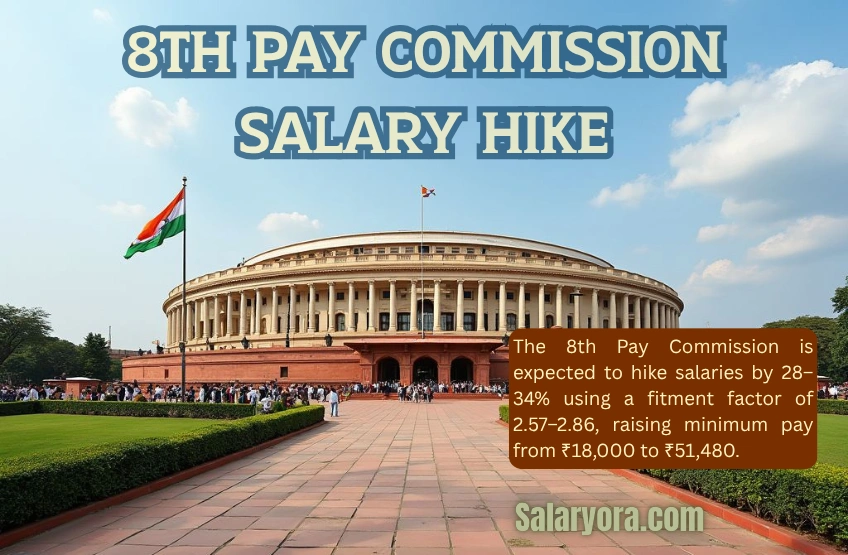
The 8th Pay Commission salary hike is expected to raise the minimum basic pay of central government employees from Rs 18,000 to somewhere between Rs 41,000 and Rs 51,480 per month, depending on the fitment factor that gets approved.
If you are a central government employee, a pensioner, or even someone preparing for a government job, this single revision will likely be the biggest salary change you see in your career. Over 48.62 lakh active employees and 67.85 lakh pensioners are watching every development closely.
Here we breaks down exactly what you can expect: the fitment factor debate, level-wise salary projections, pension hike estimates, implementation timeline, and what steps you should take right now to prepare.
Last Updated: June 11, 2026
Disclaimer: All figures in this article are based on publicly available expert projections, consultation-stage proposals, and union submissions as of June 2026. The 8th Pay Commission has not released its final report. Do not make financial decisions solely based on projected figures. Always verify with official government sources before acting.
8th Pay Commission: Key Stats at a Glance
| Parameter | 7th CPC (Current) | 8th CPC (Expected) |
|---|---|---|
| Fitment Factor | 2.57 | 2.57 to 3.83 (under debate) |
| Minimum Basic Pay | Rs 18,000/month | Rs 41,000 to Rs 51,480/month |
| Minimum Pension | Rs 9,000/month | Rs 19,350 to Rs 34,500/month |
| Maximum Basic Pay (Level 18) | Rs 2,50,000/month | Rs 6,41,750+ /month (projected) |
| DA at Implementation | 53% (Jan 2026) | Reset to 0% post-merger |
| Effective Date (Reference) | January 1, 2016 | January 1, 2026 |
| Employees Covered | ~48.62 lakh | ~48.62 lakh (same base) |
| Pensioners Covered | ~65 lakh | ~67.85 lakh |
| Expected Arrears (Level 1) | N/A | Rs 3 to 4 lakh (estimated) |
| Expected Arrears (Level 10+) | N/A | Rs 15 lakh+ (estimated) |
What Is the 8th Pay Commission?
A Pay Commission is a government-appointed body that reviews and recommends salary structures, allowances, and pension benefits for central government employees and pensioners roughly every 10 years.
The Union Cabinet approved the formation of the 8th Central Pay Commission on January 16, 2025, with Shri Arun Kumar Singh appointed as Chairman. The commission comprises a Chairperson, one part-time member, and a Member-Secretary. Its mandate covers pay revision, pension restructuring, and welfare measures for all central government staff.
The 7th Pay Commission was implemented from January 1, 2016, and concluded on December 31, 2025. The 8th Pay Commission salary revision has an official reference date of January 1, 2026, meaning even if the final report is submitted in late 2026 or 2027, arrears will be calculated from that date.
As of June 2026, the commission is in an active consultation phase, gathering memorandums from employee unions, pensioner groups, and state governments. The deadline for memorandum submission was extended to May 31, 2026.
8th Pay Commission Implementation Date: When Will the Salary Come?
This is the most common question across government offices right now.
The official reference date for the 8th Pay Commission salary hike is January 1, 2026. However, the actual date on which revised salaries will start hitting bank accounts is a different story.
Based on historical patterns, the commission’s final report is expected somewhere in mid to late 2026 or early 2027. Government approval and gazette notification typically add another few months. So realistic implementation, meaning the date you actually start receiving a revised salary, is likely in 2027 or 2028.
The good news is that arrears will be paid from January 1, 2026. Depending on your pay level and the final fitment factor, these arrears could range from Rs 3 to 4 lakh for Level 1 employees to over Rs 15 lakh for Level 10 and above positions.
| Timeline Event | Date/Period |
|---|---|
| Cabinet Approves 8th CPC | January 16, 2025 |
| Gazette Notification | November 3, 2025 |
| Memorandum Submission Deadline | May 31, 2026 |
| Reference / Effective Date | January 1, 2026 |
| Final Report Expected | Mid to Late 2026 or Early 2027 |
| Actual Salary Revision (Estimated) | 2027 or 2028 |
| Arrears Payment Start | After implementation, retroactive to Jan 1, 2026 |
The Fitment Factor: The Number That Decides Everything
If you want to understand the 8th Pay Commission salary hike in one concept, it is the fitment factor.
The fitment factor is simply a multiplier. You take your current basic pay and multiply it by the fitment factor to get your new basic pay. That is it.
Formula:
Revised Basic Pay = Current Basic Pay x Fitment Factor
Under the 7th Pay Commission, a fitment factor of 2.57 raised the minimum basic pay from Rs 7,000 to Rs 18,000. The 8th Pay Commission salary fitment factor is now the central debate.
What Different Fitment Factors Would Mean
| Fitment Factor | Minimum Basic Pay (from Rs 18,000) | Likely Scenario |
|---|---|---|
| 1.83 | Rs 32,940 | Very conservative / unlikely |
| 2.28 | Rs 41,040 | Conservative government estimate |
| 2.57 | Rs 46,260 | Moderate / mirrors 7th CPC level |
| 2.86 | Rs 51,480 | Moderate-optimistic / expert consensus |
| 3.00 | Rs 54,000 | Union-backed aspirational |
| 3.83 | Rs 68,940 | NC-JCM demand / unlikely in full |
Most financial analysts and HR experts currently expect the approved fitment factor to fall in the 2.57 to 2.86 range, similar to the approach used during the 7th Pay Commission. The NC-JCM (National Council Joint Consultative Machinery), which is the main body representing central government employees, has demanded a fitment factor of 3.83 and a minimum pay of Rs 69,000. This is seen as an aspirational ceiling rather than a likely outcome.
DA Merger: A Hidden Multiplier
Here is something many employees miss. As of January 2026, the Dearness Allowance (DA) stands at 53% of basic pay. There is a strong expectation that this DA will be merged into basic pay before the fitment factor is applied, similar to what happened during the 6th Pay Commission.
If DA is merged first, the effective base for the fitment factor calculation becomes much higher. This would significantly boost the final revised salary even at the same fitment factor. However, this DA merger is not yet confirmed and remains one of the most watched aspects of the 8th Pay Commission salary calculation process.
8th Pay Commission Level-Wise Salary Estimates
The pay matrix under the 8th Pay Commission salary structure will continue to have 18 levels, ranging from Level 1 (entry-level MTS/Group D staff) to Level 18 (Cabinet Secretary and equivalent). Below are the projected starting basic pay figures at different levels using a fitment factor of 2.57 as the baseline.
Group C and Group D (Level 1 to Level 5)
| Pay Level | Post Examples | 7th CPC Basic (Rs) | Expected 8th CPC Basic (Rs) | Annual (LPA approx.) |
|---|---|---|---|---|
| Level 1 | MTS, Peon, Constable | 18,000 | 41,000 to 46,260 | 4.92 to 5.55 LPA |
| Level 2 | LDC, Postman | 19,900 | 45,500 to 51,100 | 5.46 to 6.13 LPA |
| Level 3 | Constable GD, Junior Office Asst | 21,700 | 49,600 to 55,770 | 5.95 to 6.69 LPA |
| Level 4 | Stenographer Grade D, Clerk | 25,500 | 58,300 to 65,500 | 6.99 to 7.86 LPA |
| Level 5 | LDC Senior, Junior Accountant | 29,200 | 66,800 to 75,040 | 8.01 to 9.00 LPA |
These are basic pay projections only. Add HRA (8 to 27% depending on city), Transport Allowance, and other components for gross salary.
Group B (Level 6 to Level 9)
| Pay Level | Post Examples | 7th CPC Basic (Rs) | Expected 8th CPC Basic (Rs) | Annual (LPA approx.) |
|---|---|---|---|---|
| Level 6 | Section Officer, Inspector | 35,400 | 80,900 to 91,000 | 9.70 to 10.92 LPA |
| Level 7 | Assistant Section Officer | 44,900 | 1,02,700 to 1,15,400 | 12.32 to 13.84 LPA |
| Level 8 | Assistant Audit Officer | 47,600 | 1,08,800 to 1,22,300 | 13.05 to 14.67 LPA |
| Level 9 | Junior Administrative Grade | 53,100 | 1,21,300 to 1,36,400 | 14.55 to 16.36 LPA |
Group A (Level 10 and Above)
| Pay Level | Post Examples | 7th CPC Basic (Rs) | Expected 8th CPC Basic (Rs) | Annual (LPA approx.) |
|---|---|---|---|---|
| Level 10 | IAS Entry / Deputy Secretary | 56,100 | 1,28,200 to 1,44,200 | 15.38 to 17.30 LPA |
| Level 12 | Director, Joint Secretary | 78,800 | 1,80,200 to 2,02,500 | 21.62 to 24.30 LPA |
| Level 14 | Additional Secretary | 1,44,200 | 3,29,900 to 3,70,800 | 39.58 to 44.49 LPA |
| Level 17 | DGP / Principal Secretary | 2,25,000 | 5,14,800 to 5,78,000 | 61.77 to 69.36 LPA |
| Level 18 | Cabinet Secretary | 2,50,000 | 5,71,600 to 6,42,500 | 68.59 to 77.10 LPA |
Projections based on fitment factor range of 2.28 to 2.57. Higher-level salaries include additional allowances, official accommodations, and other perquisites not captured here.
8th Pay Commission Salary Structure: What Makes Up Your Gross Pay
The 8th Pay Commission salary structure will follow a similar framework to the 7th CPC, but with revised percentages across allowances.
| Component | 7th CPC Structure | Expected 8th CPC Structure |
|---|---|---|
| Basic Pay | Based on Level and Stage | Revised by Fitment Factor |
| Dearness Allowance (DA) | 53% of Basic (Jan 2026) | Reset to 0% after merger |
| HRA (X Cities: Metro) | 24% of Basic | Likely 27 to 30% |
| HRA (Y Cities) | 16% of Basic | Likely 18% |
| HRA (Z Cities) | 8% of Basic | Likely 9% |
| Transport Allowance | Rs 3,600 to Rs 7,200/month | Expected revision upward |
| Annual Increment | 3% of Basic | Possible revision to 5% |
Employee unions have specifically demanded that the annual increment rate be raised from 3% to 5% and that the pension commutation restoration period be reduced from 15 years to 10 to 12 years. These are active proposals, not confirmed changes.
8th Pay Commission Pension Hike: What Retirees Can Expect
For pensioners, the 8th Pay Commission salary pension hike calculation works the same way as for active employees. The same fitment factor is applied to the current basic pension to arrive at the revised basic pension.
Formula:
Revised Pension = Current Basic Pension x Fitment Factor
| Fitment Factor | Minimum Pension (from Rs 9,000) | Maximum Basic Pension |
|---|---|---|
| 2.15 | Rs 19,350 | Proportional increase |
| 2.57 | Rs 23,130 | Proportional increase |
| 2.86 | Rs 25,740 | Proportional increase |
| 3.00 | Rs 27,000 | Proportional increase |
| 3.83 | Rs 34,470 | Proportional increase |
The Dearness Relief (DR), which is the pensioner equivalent of DA, will also be reset to 0% after the new pension is calculated and then revised periodically like before.
Around 67.85 lakh central government pensioners are expected to benefit from the 8th Pay Commission salary pension hike once it is implemented.
8th Pay Commission Salary Hike Predictions: Three Scenarios
Here is how experts are currently mapping out the possible outcomes:
Scenario 1: Conservative (Fitment Factor 2.28)
- Minimum basic pay rises from Rs 18,000 to Rs 41,040
- Minimum pension rises from Rs 9,000 to Rs 20,520
- Total gross salary increase (including allowances): approximately 25%
- Likely if government prioritizes fiscal prudence
Scenario 2: Moderate (Fitment Factor 2.57 to 2.86)
- Minimum basic pay rises from Rs 18,000 to Rs 46,260 to Rs 51,480
- Minimum pension rises to Rs 23,130 to Rs 25,740
- Total gross salary increase: approximately 30 to 34%
- Considered the most likely outcome by analysts
Scenario 3: Optimistic (Fitment Factor 3.83)
- Minimum basic pay rises from Rs 18,000 to Rs 68,940
- Minimum pension rises from Rs 9,000 to Rs 34,470
- Total gross salary increase: approximately 50%+
- This is the NC-JCM demand; broadly seen as aspirational
How to Calculate Your 8th Pay Commission Salary
The 8th Pay Commission salary calculation follows this step-by-step process:
Step 1: Find your current basic pay from your latest salary slip (your Level and Stage in the 7th CPC pay matrix).
Step 2: Multiply your current basic pay by the fitment factor.
Example: Basic Pay of Rs 35,400 x 2.57 = Rs 90,978 (rounded to the next stage cell)
Step 3: Add the revised HRA based on your city category (X, Y, or Z).
Example: 27% of Rs 90,978 = Rs 24,564 (for a metro city)
Step 4: Add Transport Allowance based on your city and level.
Step 5: Add any other applicable allowances (children education, medical, etc.)
Step 6: DA starts at 0% post-revision and gets revised every six months going forward.
8th Pay Commission Salary Revision Estimates: Past vs Present
Looking at the history of pay commissions gives a clearer picture of what to expect.
| Pay Commission | Year | Fitment Factor | Minimum Pay (Pre) | Minimum Pay (Post) | % Hike |
|---|---|---|---|---|---|
| 5th CPC | 1997 | 1.0 (fixed pay bands) | Rs 750 | Rs 2,550 | 240% |
| 6th CPC | 2006 | 1.86 | Rs 2,550 | Rs 6,660 | 40%+ |
| 7th CPC | 2016 | 2.57 | Rs 7,000 | Rs 18,000 | 14 to 23% |
| 8th CPC | 2026 | 2.28 to 3.83 (expected) | Rs 18,000 | Rs 41,000 to Rs 69,000 | 28 to 34%+ |
The trend clearly shows that each successive commission has used a higher fitment factor, with the minimum pay growing significantly in each decade. The 8th Pay Commission salary hike is expected to continue this upward trajectory.
Tax Impact: Higher Salary, Smarter Planning Needed
A higher revised salary under the 8th Pay Commission salary structure will have direct tax implications. If your gross salary increases significantly, you may move into a higher income tax slab under the new tax regime.
For example:
- A Level 7 employee whose gross income moves from around Rs 12 LPA to Rs 15 to 16 LPA will now fall into the 20% slab under the new regime on the incremental portion.
- Arrears received as a lump sum in 2027 or 2028 will be fully taxable in the year of receipt, unless relief under Section 89(1) of the Income Tax Act is claimed using Form 10E.
Key tax planning actions:
- File Form 10E proactively when arrears are paid to claim Section 89(1) relief and avoid paying tax at a higher slab on the lump-sum arrears.
- Consider maximizing NPS contributions (up to Rs 50,000 additional deduction under Section 80CCD(1B) in old regime) to reduce taxable income.
- If you are close to a salary slab boundary, review your exemptions early.
Who Benefits Most From the 8th Pay Commission Salary Hike?
Not all employees benefit equally. Here is a quick breakdown:
| Employee Group | Level Range | Key Benefit |
|---|---|---|
| Group D / MTS | Level 1 to 2 | Biggest percentage jump in basic pay |
| Clerks / LDC / Constables | Level 3 to 5 | Solid hike plus DA merger gains |
| Section Officers / Inspectors | Level 6 to 9 | Strong increase with HRA revision |
| IAS / IPS Entry Level | Level 10 to 12 | High absolute gain in LPA terms |
| Senior IAS / Secretaries | Level 14 to 18 | Largest absolute rupee gain |
| Pensioners (all categories) | All | Same fitment factor applied to basic pension |
What Employee Unions Are Demanding
The NC-JCM submitted its formal memorandum before the May 31, 2026 deadline with the following key demands:
- Fitment factor of 3.83 (raising minimum pay to Rs 69,000)
- Annual increment raised from 3% to 5%
- DA merger into basic pay before fitment factor application
- Minimum pension raised from Rs 9,000 to at least Rs 25,000
- Pension commutation restoration period cut from 15 years to 10 to 12 years
- Minimum basic pay to be determined using the price index as of January 1, 2026
These demands represent the ceiling. The government’s counter will be shaped by fiscal prudence, the prevailing inflation rate, and economic growth conditions at the time of the commission’s final report.
8th Pay Commission vs 7th Pay Commission: Side-by-Side
| Aspect | 7th Pay Commission | 8th Pay Commission |
|---|---|---|
| Constituted | February 28, 2014 | January 16, 2025 |
| Effective From | January 1, 2016 | January 1, 2026 |
| Fitment Factor | 2.57 | 2.28 to 3.83 (proposed) |
| Min Basic Pay | Rs 18,000 | Rs 41,000 to Rs 69,000 |
| Min Pension | Rs 9,000 | Rs 19,350 to Rs 34,470 |
| DA at Revision | Merged/Reset | Likely merged then reset |
| Pay Levels | 18 Levels | 18 Levels (continuing) |
| Employees Covered | ~47 lakh | ~48.62 lakh |
| Report Submission Target | Within 18 months | Within 18 months (from Jan 2025) |
Conclusion
The 8th Pay Commission salary hike is shaping up to be one of the most significant revisions in Indian government pay history. Here are the key takeaways:
- The official reference date is January 1, 2026, but actual revised salaries are likely from 2027 or 2028.
- The fitment factor will determine everything. Experts expect it to land between 2.57 and 2.86.
- The minimum basic pay is projected to rise from Rs 18,000 to somewhere between Rs 41,000 and Rs 51,480.
- Pensioners will see the minimum pension rise from Rs 9,000 to at least Rs 19,350 and possibly Rs 25,740.
- Arrears from January 1, 2026 will be paid as a lump sum, potentially amounting to Rs 3 to 15 lakh+ depending on your level.
- The DA merger into basic pay, if approved, will further boost the effective hike.
- Start tax planning early, especially for arrears relief under Section 89(1).
Keep checking official sources like the MyGov Portal, the 8th Pay Commission official website, and the Government of India Gazette Notifications for the latest confirmed updates.
? FAQs About 8th Pay Commission Salary Hike
Q1. What is the expected 8th Pay Commission salary hike percentage?
Around 28 to 34%, depending on the final fitment factor approved.
Q2. When will the 8th Pay Commission salary actually be implemented?
Likely in 2027 or 2028, with arrears paid from January 1, 2026.
Q3. What is the expected fitment factor under the 8th Pay Commission?
2.57 to 2.86 as per expert consensus. Unions are demanding 3.83.
Q4. How much will the minimum basic pay increase under the 8th Pay Commission?
From Rs 18,000 to an estimated Rs 41,000 to Rs 51,480 per month.
Q5. Will pensioners also benefit from the 8th Pay Commission salary pension hike?
Yes. The same fitment factor applies to basic pension. Minimum pension could rise from Rs 9,000 to Rs 19,350 to Rs 25,740.
Q6. What is the DA situation under the 8th Pay Commission?
DA of 53% is expected to be merged into basic pay at implementation, then reset to 0%.
Q7. How will the 8th Pay Commission affect tax outgo?
Higher basic pay means higher taxable income. File Form 10E to claim arrears relief under Section 89(1).
Q8. How much arrears can I expect from the 8th Pay Commission?
Rs 3 to 4 lakh for Level 1. Rs 15 lakh or more for Level 10 and above.
If You Found This Article Helpful, Do Check Out Our Previous Blog On [ Vishal Mega Mart Security Guard Job Salary ] For More Detailed Salary And Career Breakdowns.
